design · full stack
Process engine
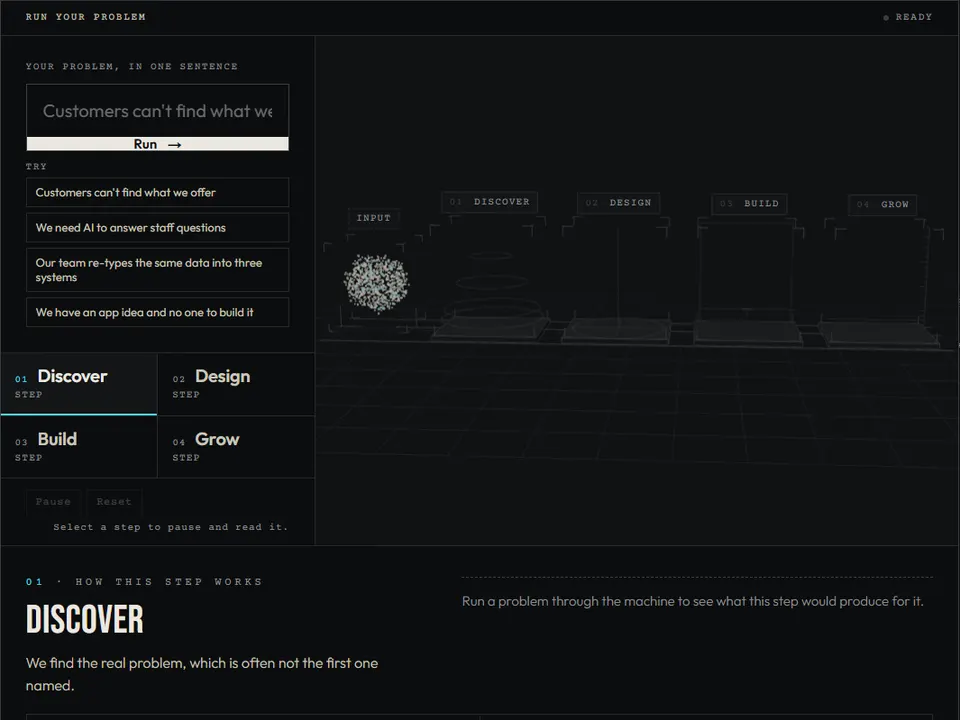
An interactive 3D machine in plain three.js and WebGL. Describe your problem and watch it move through Discover, Design, Build and Grow, step by step.
Explore Process engine01 / Home
Strategy · design · code · AI
From question to launch.
Most problems don't arrive sorted by discipline. A product needs a clear position, an interface people understand, software that holds up and, more and more, AI that does real work. I carry all four, so nothing gets lost between hand-offs.
02 / Journey
Every project follows the same four steps: we discover what's really wrong, design the answer, build it properly and help it grow. You always know which step we're in, what you'll get from it and what I need from you.

You run a business, a team or an organisation and something isn't working: a process, a product, a message. Start with the four steps below, then see similar work.
You need someone who can own a problem across AI, engineering and design. The fastest proof is the Work case studies, the Lab tools you can try right now, and how I work in Principles.
You have a venture, a product idea or a partnership in mind. Read Principles for how I make decisions, then start a conversation.
We find the real problem, often not the first one named.
We find the real problem, which is often not the first one named. I talk to the people involved, look at what exists (your site, your data, your process) and restate the problem in one page you can agree with or correct.
You get: a problem statement, what success looks like, and the smallest useful first version.
I need from you: an honest hour or two, and access to what exists.
We shape the answer before writing much code.
We decide what the answer looks like before writing much code. That covers positioning and message, the shape of the product, and the screens or flows people will use.
You get: a clear direction you can react to: a positioning statement, flows and key screens, or a working prototype.
I need from you: quick, honest feedback.
End to end, in small releases you can see.
I build it end to end: interface, backend, data and any AI, with tests and documentation, in small releases you can see.
You get: working software you own, deployed where you choose.
I need from you: decisions when trade-offs come up.
Launch is the start: watch, fix, improve.
Launch is the start. We watch how it's used, fix what's unclear and improve what matters most.
You get: a short list of what to improve next, based on how people actually use it.
I need from you: time to look at the results together.
It depends on the problem, so the first step always ends with a scoped plan and timeline. Small, focused builds take weeks; platforms take longer and ship in stages.
You do. Code, designs and content are yours, in your accounts.
We agree on it up front: a handover with documentation, a short support window, or ongoing work. See the formats in Principles.
I like problems that need more than one kind of thinking. I'll tell you plainly what I'd do, what I wouldn't, and why.
03 / Frontiers
Most products stall in the gaps between specialists: the strategy that never reached the interface, the design that was too costly to build, the AI feature nobody could explain. I work across all four, so each decision is made knowing what it means for the others.
The toolkit
Then what we learn from real use flows back into the strategy.
Problems I take on: answering questions from your documents, automating repetitive work with agents, adding AI features to an existing product, deciding whether you need AI at all.
You receive: a working system, an evaluation set that shows how well it performs, and a plain-language explanation of its limits.
Problems I take on: a first version of a product, a portal that replaces paperwork, a slow or fragile system that needs rebuilding, integrations between tools.
You receive: deployed software you own, with tests, documentation and a handover.
Problems I take on: confusing products, brands that look unfinished, websites that don't explain the offer, ideas that need an interactive demo.
You receive: design systems, key screens, brand assets, and production-ready interactive pieces.
Problems I take on: "people don't get what we do", a technical product that's hard to explain, a launch that needs a clear story.
You receive: a positioning statement, a message hierarchy, and the words for your site, deck and product.
For focused products and early stages, yes, and it's often faster because nothing is lost in hand-offs. For large-scale or regulated systems I'll say when you need a bigger team. More in the note Can one person handle strategy, design and the build?
No. The work you see is mine. If a project needs a specialist I don't cover, I'll tell you up front.
04 / Work
Each case study starts with the problem, then the constraints, what I did across strategy, design, code and AI, and what exists now. Where something is a prototype or a proposal, it says so. Where it isn't measured yet, it says that too.
Every case lists my role, the stack and "what I'd change next time". If you'd like to walk through the code or decisions behind one, ask me.
Drag or scroll over it to turn · click a project to open its prototype. Use the up and down arrow keys, or Tab, to move between projects, and Enter to open one.
A working prototype of a digital town hall for the Municipality of San Francisco, with 20 office workspaces, linked workflows and an AI receptionist, built on mock data by a team of specialized AI agents I designed and directed.
PasinPay is an emerging-market mobile wallet designed to run through a licensed partner bank, delivered by a team of 11 specialized AI agent roles. It has a clickable prototype of all 12 flows and a backend starter whose database refuses bad money data.
A Python crawler and Claude Code agent that turn a URL into a readable blueprint of a website: stack, structure, journeys and diagrams. It mapped all 43 benchmark sites behind this site's research.
ClassPulse is product work for the Sitapatr Pratom English Program: one app for marks, evaluations, parent reports, timetables and staff records, built on the school's real grading formula, with an AI lesson-plan assistant.
A prototype redesign of the Municipality of San Francisco's public website, with services, officials, emergency information, 3D maps and two languages, built to pitch alongside e-Serbisyo. Not the official site.
The shop from my proposed rebuild of ZAD ZEAL's website: immersive galleries of hand-made bags, blouses and local designs, product pages with every design, and a cart that turns into a ready-to-send WhatsApp order.
A redesign prototype for a gemstone appraisal and consultation business. It carries every article, page and document from the old WordPress site into a searchable library, wrapped in a chaptered story with live 3D gems.
An independent concept rebuild of a national aviation regulator's website. It turns 424 hard-to-find PDFs into a searchable reader, maps licensing journeys step by step and adds a live 3D aviation viewer.
A study app that maps government from national level down to the village, with every office, position and duty, a what-if editor and a seven-lesson course.
Shave the Frog is a client's philosophical streetwear label. I worked on their brand strategy, identity and content plan, then hand-built and deployed their website. The online store is not built yet.





05 / Lab
The Lab is where you can test what I do instead of taking my word for it. Every tool is free, needs no account, and keeps your work on your own device. Each one has its own page, a short note on how it works, and the code behind it.
Scroll over the dial to discover.Swipe the dial to discover.Or use the arrow keys.
THE LAB
design · full stack
An interactive 3D machine in plain three.js and WebGL. Describe your problem and watch it move through Discover, Design, Build and Grow, step by step.
Explore Process engineai engineering · full stack
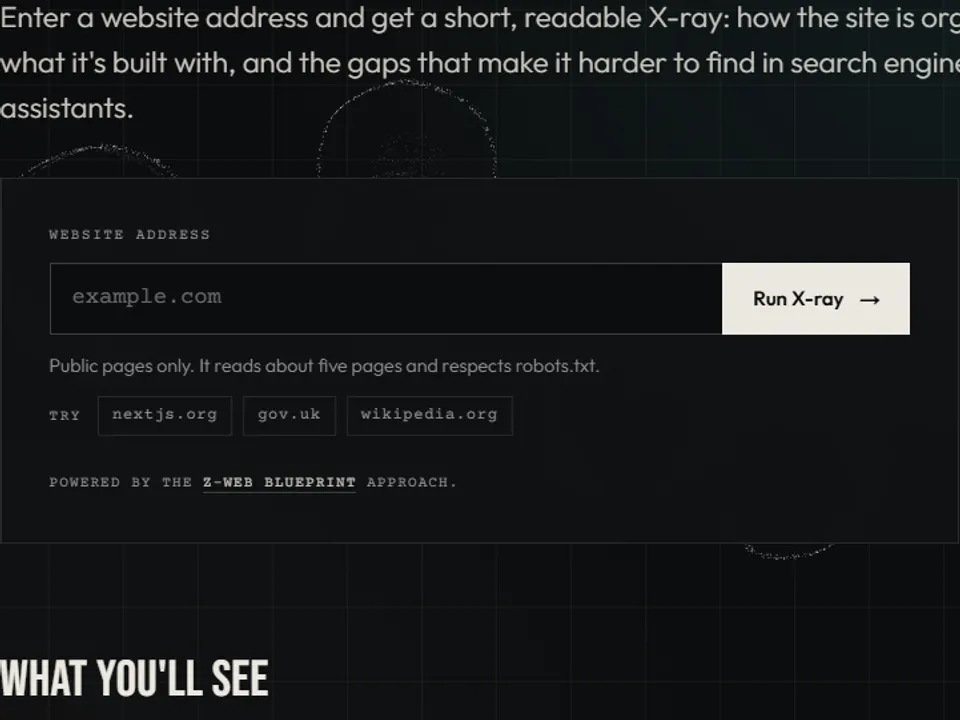
Enter a website and see its structure, technology and the SEO and AI-search gaps holding it back. Free, no sign-up, powered by my Z-web blueprint agent.
Explore Site X-raybrand strategy
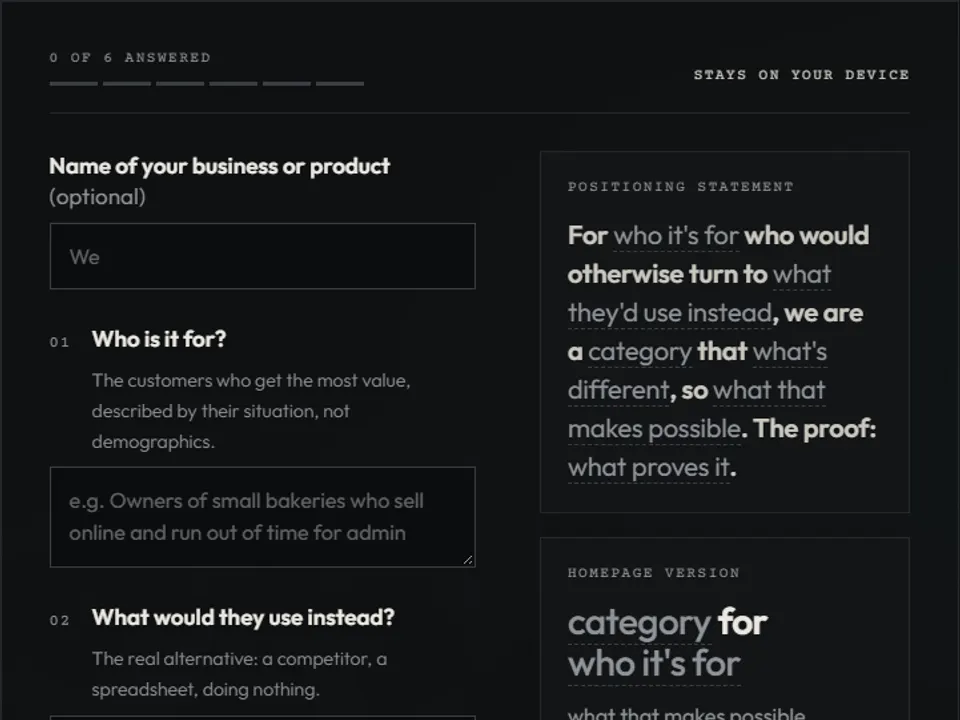
A free, guided canvas to define who you serve, what they'd choose instead and why you're better, ending in a positioning statement you can test.
Explore Positioning canvasdesign · full stack
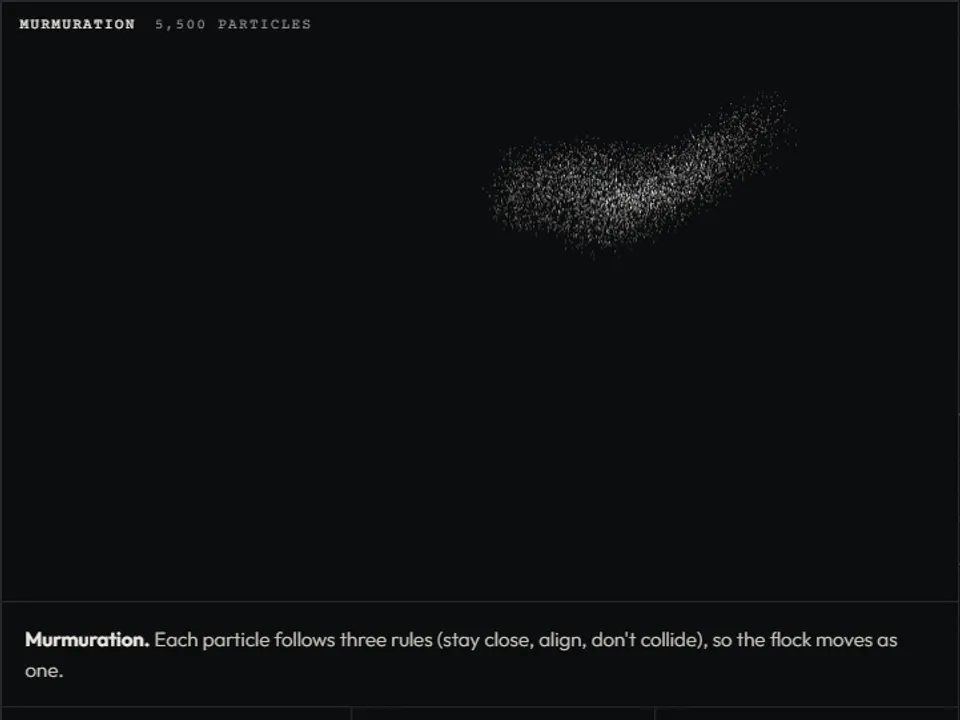
Play with the GPU particle systems behind this site: murmurations, mycelium, phyllotaxis and flow fields. Change the forces and share a snapshot.
Explore Particle playgroundProcess engine, tool 01 / 04
The Notes and selected Lab tools are available to AI agents through this site's MCP endpoint and llms.txt.
06 / Principles
These are the commitments behind every project. They answer the questions people usually only ask once something has gone wrong: who owns what, how data is handled, how progress is reported, and what happens when plans change.
A demo proves an idea; a product has to survive real users, bad data and Monday mornings. I build for the second.
I don't quote results I haven't measured. We agree on what success looks like, then we check.
Animation and 3D should explain, never get in the way. Everything I make respects reduced-motion settings and works without them.
Collect only what's needed, keep it only as long as needed, and say so clearly.
It's used only for your project, stored where you agree, and never used to train public AI models without your consent.
least-privilege access, secrets kept out of code, dependencies kept current, and security headers set from day one.
when time, scope and quality pull against each other, I lay out the options and recommend one.
Every engagement starts with the Discover step, so the scope is clear before you commit.
07 / Contact
Email is the best way to reach me. Tell me what isn't working, your timeline, and what success would look like. I read every message myself and reply personally.